
GOAL DIRECTED LEARNING

How should a data warehousing / business intelligence project be managed? Planning and organizing the data warehouse project includes:
Defining the correct scope and setting realistic objectives are key to data warehouse project success. Scope defines project boundaries including:
Objectives define project success criteria including quantified planned benefits.
Defining an overly large project scope and letting scope grow in an uncontrolled fashion (scope creep) are sure fire ways to hurt the chance of project success.
Remember you can't please everyone:
|
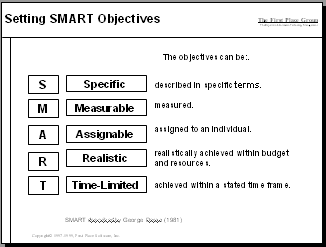
We recommending the SMART objectives approach when setting goals and objectives.
Be alert against making these common data warehousing missteps:
The Methodology article provides a step by step approach that should help you to avoid these problems. For further understanding of best and worst practices see the article titled Sustaining Data Warehousing and Business Intelligence.
The choice of Enterprise Data Warehouse vs Data Mart is key to the success of data warehousing projects.
The Enterprise Data Warehouse is:
While the Data Mart is:
The project may require both an Enterprise Data Warehouse and one or more Data Marts. The Technical Architecture explains more about this choice.
The right team is key to any successful project and data warehousing projects are no different. The following roles are needed for an effective data warehousing project team:
The executive sponsor is a senior management person who takes overall responsibility for a project. A good project sponsor typically is a:
The project sponsor fills a number of roles including:
For more information see Terence J. Cooke-Davies' excellent article, The Executive Sponsor – The Hinge upon which Organisational Project Management Maturity Turns? that describes the role of the project sponsor.
[PAGE_BREAK]
The Project Roadmap is larger in scope than a single project plan. It encompasses a series of projects that carry the organization forward to longer range objectives.
An individual project will include:
Answering critical questions is another key to project success:
|
The purpose of the proposed project plan is:
The proposed project plan contains:
Approving the plan includes committing to the proposed resource level as well as approving the stated objectives.
Scope specifies the boundaries of the project. It tells what’s in and what’s out. This effort includes:
The Work Package Plan is a detailed plan that breaks a project down to the activity level. The first part of this work includes building an activities list using techniques such as brainstorming, templates and checklists. This is followed up with these further efforts.
The budget is an itemized projection of the resources need for the project including the amount of money needed for item. Here are some of the major items that should be included in the budget:
The people budget can be determined by multiplying the hours estimated in the Work Package Plan by the rates. The projections for hardware, software and external data depend upon the Technical Architecture selected. Be sure to add some contingency time in case the project does not go as planned.
Make sure that the data warehousing team is trained in the skills needed for success. Review each role and team member for needed skills and train as needed. Team members may require skills in areas such as:
Advertisements:

Infogoal.com is organized to help you gain mastery.
Examples may be simplified to facilitate learning.
Content is reviewed for errors but is not warranted to be 100% correct.
In order to use this site, you must read and agree to the
terms of use, privacy policy and cookie policy.
Copyright 2006-2020 by Infogoal, LLC. All Rights Reserved.