GOAL DIRECTED LEARNING
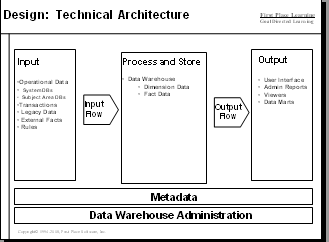
Which relational database should you choose for the staging, data warehouse and data mart databases that make up the data warehousing system? In addition, which version and feature set are the best choice? As you can see by this data warehouse architecture diagram there are a number of databases involved:
|
|
First look at your goals and objectives. Requirements you may consider when evaluating include:
Performance features to consider:
Financial Considerations:
There are a number of databases that you may want to consider. The following databases and their respective vendors are market leaders that you are likely to evaluate:
There are other very good database systems such as Sybase-IQ and Postgres.
DB2 from IBM is definitely an alternative to consider if your organization runs an IBM shop with AIX or z/OS operating system.
|
Strengths |
Weaknesses |
|
|
DB2 has a number of versions and supports multiple platforms. The Express-C version of the system differs from other express versions in that there is no limit on database size. The Data Warehouse Edition (DWE) packages DB2 Enterprise Server along with:
IBM has developed a means of speeding queries by storing pre-computing values called Materialized Query Tables (MQT). This helps DB2 to be highly scalable.
MySQL from Sun Software is the world's most popular open source DBMS. It has proven itself in many situations with successes with companies like LinkedIn, Dow Corning and the NBC Olympics.
|
Strengths |
Weaknesses |
|
|
With MySQL, you can start with the Community Edition and then upgrade to the Enterprise Edition for production work.
Oracle provides an industry leading relational database plus a suite of business intelligence products.
|
Strengths |
Weaknesses |
|
|
Oracle does provide a free Express version, so it is possible to start at a low cost.
SQL Server 2005 from Microsoft is a great choice when the environment is Windows and moderate scalability is required.
|
Strengths |
Weaknesses |
|
|
SQL Server 2019 has a number of versions ranging in price from free to over $25,000. If you want to learn SQL Server or do a proof of concept, the Developer version is a bargain. Keep in mind that if multiple platforms such as development, test and production are needed the cost will increase.
|
Express |
Developer |
Work Group |
Standard |
Enterprise | |
| CPU | 1 | 1 | 2 | 4 | No Limit |
| RAM | 1 GB | 3 GB | 3 GB | No Limit | No Limit |
|
Database |
4 GB | 4 GB |
No |
No Limit | No Limit |
| Advanced Features |
No | No | No | No | Yes |
| UI | Basic | Studio | Studio | Studio | Studio |
| OLAP | No | Yes | No | Yes | Yes |
| Reporting | No | Yes | No | Yes | Yes |
| Approx Price | Free | $50 | $3.9K | $6K | $25K |
Please check with vendor for most current prices and features. The prices and features presented on this page are for information only.
Teradata has a long history of supporting large scale databases aimed at data warehousing and business intelligence. Teradata provides both the relational database software and the hardware that supports it.
|
Strengths |
Weaknesses |
|
|
Consider Teradata when large databases that support many users are needed.
In conclusion, there a number of relational database choices available to support data warehousing and business intelligence. These database choices cover a wide range of scalability and price.
Advertisements:

Infogoal.com is organized to help you gain mastery.
Examples may be simplified to facilitate learning.
Content is reviewed for errors but is not warranted to be 100% correct.
In order to use this site, you must read and agree to the
terms of use, privacy policy and cookie policy.
Copyright 2006-2020 by Infogoal, LLC. All Rights Reserved.